
The Hidden Hours in Every Drawing Office: What Documentation and Project Admin Really Cost Your Technical Team
The Melbourne engineering principal opened the meeting the way principals usually open these meetings. "We are flat out. We do not have the capacity for another project without another hire." Then he pulled up his team's timesheets to prove it. He was right about the hours. Every senior engineer in the practice was pushing forty five plus, week after week. He was wrong about the work.
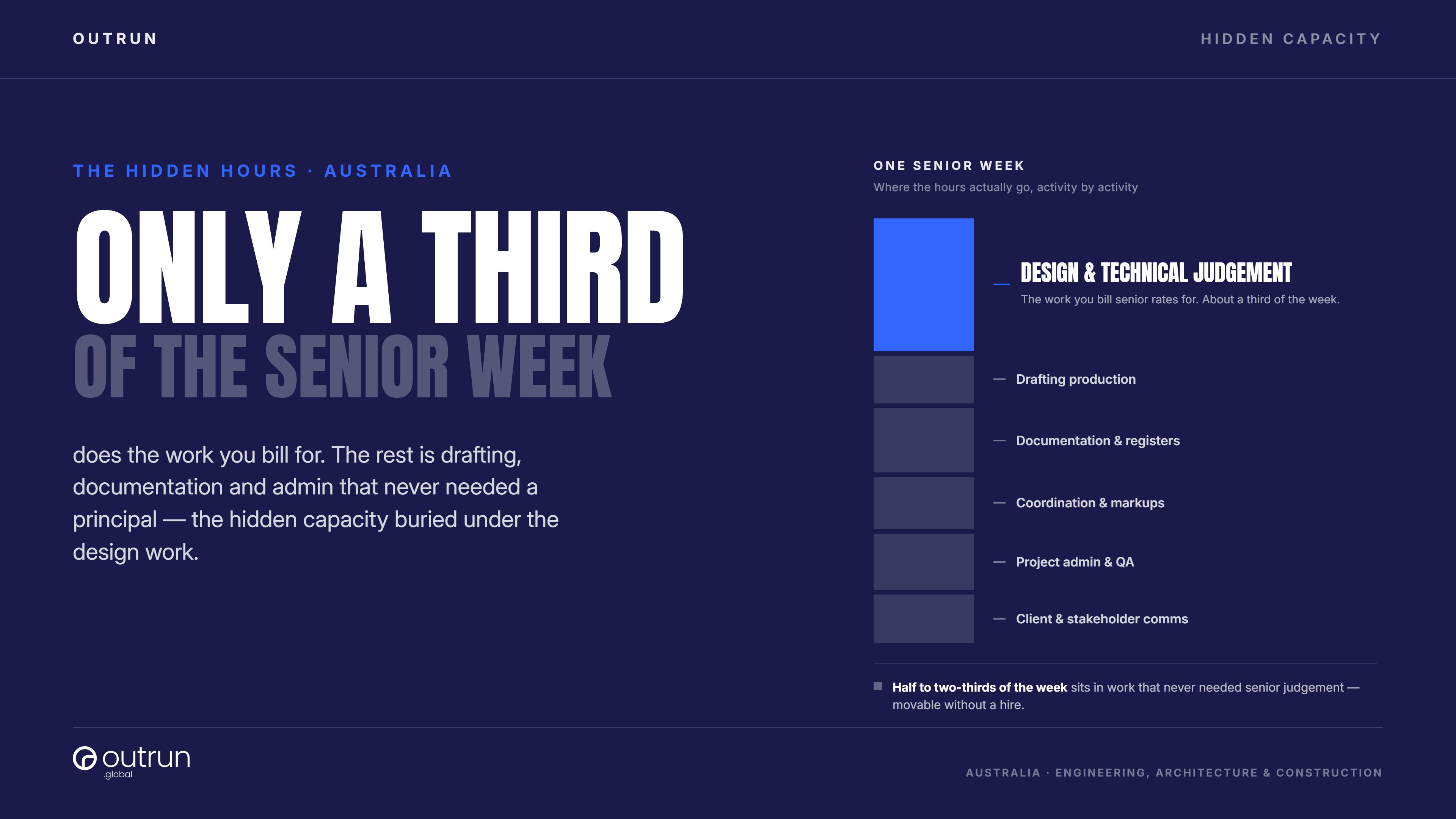
An hour later, when we had mapped a real week activity by activity, the conversation shifted. His senior technical people were not short of hours. They were short of hours spent on the work they were hired to do. The design decisions, the client-facing problem solving, the technical judgement calls his firm bills for: those took up roughly a third of the senior engineering week. The rest sat in drafting revisions, document control, RFI responses, drawing register updates, tender documentation, and project admin. Work that any qualified drafter could do. Work he was, in effect, paying an experienced principal engineer to do at three times the cost.
That principal is not an outlier. Across Australian architecture, engineering, and construction firms, senior technical time is the scarcest resource in the practice and the least protected. This is what capacity looks like when you measure it properly. It is not missing. It is buried. And once you can see it, you can move it.
The staffing question that is really a work question
The default response to a stretched technical team in Australia is to hire. Post the role, wait through a market that took a national average of about seventy one days to close a senior hire in mid 2026 according to Jobs and Skills Australia, pay the placement fee, absorb the ramp up, and hope this one stays. Meanwhile the team keeps grinding, senior deadlines slip, and the principal keeps working weekends.
Sometimes another hire is genuinely the answer. Growth demands it, the work is genuinely there, and the practice has the pipeline to justify the fully loaded cost. But in a lot of firms we sit with, hiring is the reflex answer to a work allocation problem. The senior people are not overloaded with senior work. They are overloaded with everything else that has drifted onto their desks because there was no one else to catch it, or because the practice never stopped to ask which activities actually needed their expertise and which did not.
This is what we mean by hidden capacity. It is the gap between what your senior technical people were hired to deliver and what they actually spend their week doing. Close that gap, even partially, and you have found capacity without adding a role, a payroll line, or a six month settling-in period.
Where the technical week actually goes
We have measured a lot of technical weeks. Across the drafting, documentation, engineering, and quantity surveying work we have analysed inside Australian and New Zealand firms, the pattern is consistent enough to plan around. A senior technical week tends to break into six activity clusters, and the cluster that carries the practice's real intellectual property is smaller than any principal would guess.
The first cluster is design and technical problem solving. Concept development, structural or systems reasoning, decisions that draw directly on twenty years of experience. This is the work firms actually bill senior rates for. In the practices we measure, it consistently sits at around a third of the senior week. Sometimes less.
The second cluster is drafting production. Turning design intent into CAD output, revising sheets, chasing sheet references, updating title blocks. This work must be done, and it must be done accurately, but it does not require a principal's judgement. It requires a competent drafter working to a technical standard.
The third is documentation. Specifications, schedules, drawing registers, RFI responses, transmittal notes, tender documentation, as-built package assembly. This is the work that quietly consumes evenings. It is administrative in nature, technical in content, and it multiplies with every project the practice takes on.
The fourth is coordination. Chasing consultants for markups, following up on approvals, reconciling drawings across disciplines. Vital work. Not senior work.
The fifth is project admin. Time sheets, invoicing narratives, project setup, folder structure, template management, QA sign-offs on documents drafted by juniors.
The sixth is client and stakeholder communication that is not design led. Progress emails, meeting minutes, action item tracking, courtesy calls that could be triaged.
Add the last four clusters together and you get somewhere between fifty and sixty five per cent of the senior technical week, week in week out. That is the iceberg under the design work. It is the reason your best people are the busiest people in the practice and also the reason projects still slip.
Why this stays invisible
Practice owners do not miss this because they are not paying attention. They miss it because the reporting they have does not surface it. Timesheets track billable versus non-billable at the project level. They rarely track activity below that. A senior engineer marking eight hours to project 24-118 does not, in the timesheet, distinguish between four hours of structural reasoning and four hours of drawing register housekeeping. Both count as project time. Both look identical in the weekly report.
The other reason it stays invisible is that everyone in the practice has adapted around it. Juniors have grown up seeing seniors do drafting revisions personally, so they do not push to take them on. Principals have learned that if they want a document delivered without a mistake they had better draft it themselves. Clients ring the senior engineer directly because that is who they got last time. The pattern hardens quietly, project by project, until it looks like the way work has to be.
When we sit with a practice for an Activity Analysis Session, we spend the first hour on this. Not on solutions. Not on offshoring. Just on measuring where the senior week actually goes, activity by activity, with the principals in the room looking at their own numbers. The reactions vary. What does not vary is the moment someone in the room says "I did not think it was that bad."
The cost of the wrong seat doing the work
There is a commercial argument here that gets skipped too often. Every hour a senior engineer spends on drafting revisions is an hour billed at senior rates for work a drafter could deliver. In a fully loaded sense, that includes salary, superannuation at twelve per cent, leave, insurance, tools, and the on costs the practice absorbs before it makes a dollar of margin. Depending on the role and market, a senior engineering hour in Australia loads out three to five times the cost of a competent drafting hour. When forty per cent of the senior week is going to work that does not require senior judgement, the arithmetic is straightforward. The practice is quietly overpaying for a large fraction of its most expensive labour.
The second cost is the one principals feel more than they can measure. It is the cost of the senior work not getting done. The tender that would have been sharper if the principal had another two hours to think about it. The technical review that got skipped because there was no time. The client conversation that ended in a "leave it with me" instead of a decision. These do not show up on any dashboard. They show up two quarters later as tender win rates, project margins, or referrals that did not come.
Curious what your own firm's number looks like? The Hidden Capacity Calculator gives you a first pass in about ten minutes.
What a work allocation review actually looks like
The move from "we need to hire" to "we need to look at where the week goes" is a straightforward diagnostic move, and it does not require any technology. It requires two things: a structured way to observe the work, and someone in the room who is not defending the current arrangement.
The observation part matters more than most owners expect. Estimates are unreliable here. Ask a principal how much of their week goes to drafting revisions and they will guess low, because the revisions blend into the design work in their own head. Measure it activity by activity for a fortnight and you get a different number. The gap between what the practice thought was happening and what is actually happening is the diagnostic finding. It is what unlocks the room.
The neutral facilitator matters because everyone in the practice has a stake in the status quo. Principals feel loyal to the way they have always worked. Juniors do not want to look like they cannot handle more. Practice managers have processes built around the current allocation. An outside pair of eyes gives the practice permission to see the shape of the week clearly and then to redesign it deliberately.
Our Activity Analysis Session is one version of this diagnostic. It runs for about an hour, uses our activity framework and a working sample of the practice's real week, and produces two outputs. The first is a picture of where the senior technical time is actually going, cluster by cluster, expressed as a percentage of the fully loaded week and a dollar figure of loaded labour. The second is a shortlist of activities that could be moved off senior desks without any loss of quality or client outcome. That shortlist is the practice's hidden capacity, made visible.
What happens after the diagnostic
Making capacity visible is not the same as capturing it. The activities on that shortlist have to go somewhere. In practice, they go to one of three places, and the right answer for a given firm depends on the shape of the work, the local talent market, and the firm's tolerance for change.
The first option is redistributing inside the practice. If a firm has capable drafters who are underutilised, or juniors ready for more responsibility, the shortlist can move onto their desks with the right supervision and quality process. This is the cheapest option. It also has limits. Junior drafters who are already fully loaded cannot absorb more work simply because the numbers say they should.
The second option is process redesign. Some of the activities on the shortlist should not be done at all, or should be done at half the current effort. Drawing registers can be automated. Standard details can be templated once and reused. RFI responses can be triaged by a project coordinator before they hit a senior desk. Every hour saved this way is capacity captured with no new labour cost.
The third option is offshore augmentation. For firms that have already redistributed and redesigned as far as they can, adding capable offshore drafting, documentation, and project admin capacity is often the fastest way to move the remainder off senior desks. The tests here are practical. Can the offshore team members work to the firm's standards? Can they hold their own on drawing sets that draw on Australian codes and conventions? Do they stay with the firm long enough to be worth training? The activity level view is what makes this decision easy. You are not offshoring "engineering." You are offshoring a specific list of activities that any qualified drafter could do, and you are matching those activities to people who can deliver them at that standard.
What this looks like when it works
The Melbourne principal in the opening paragraph did not need another senior engineer in his practice. He needed three activities off his senior desks. Drawing register maintenance, first pass RFI drafting, and tender documentation assembly. Once those three moved, his two senior engineers gained about a day and a half of technical judgement time each week. That day and a half is where the firm's tender win rate lives. It is where the technical reviews that catch expensive errors happen. It is what he was hired to do when he founded the practice fifteen years ago.
The practice did not save the equivalent of a senior hire. It found more than the equivalent of a senior hire. And it did so without a placement fee, without a settling-in quarter, and without gambling on the seventy one day hiring market.
That is what hidden capacity looks like when you go find it. It is not a magic trick. It is measurement, honest conversation, and a redesign of who does what. The reason it feels like a discovery every time is that most practices have never done the measurement.
Where to start
If you run an Australian engineering, architecture, drafting, or project delivery practice and your senior people are visibly flat out while your projects still slip, the first move is not a job ad. The first move is an activity level view of one senior technical week.
Two ways to start. The Hidden Capacity Calculator gives you a rough view of what your practice is likely paying for work that does not need senior expertise, in about ten minutes and without a conversation with us. It is a starting number, not a diagnostic, and it is deliberately conservative.
The Activity Analysis Session is the diagnostic. About an hour with your team, with our framework and facilitation, using a real week from your practice. You will finish with a picture of where the senior time is going, a shortlist of activities that can be moved, and a view of the fully loaded dollar figure sitting inside the wrong seats.
Your senior engineers were hired to solve problems, not to format drawings and chase document control. The capacity you need is already on the payroll, buried in work that never needed their expertise. It is worth the hour to go and find it.
Book an Activity Analysis Session and see the shape of your senior week, activity by activity.

Explore more categories
Partner Resources
Read the Full Guide
The New Zealand and Australian Accountant's Guide to Advising on Offshore Solutions are the 20-minute and 30-minute companion resource covering the complete regulatory framework, cultural navigation, liability management, and conversation methodology. The toolkit extracts the practical tools from that guide.
Get fresh cost saving tips & insights, monthly
Unsubscribe anytime

Outrun places admin professionals in the Philippines with New Zealand and Australian businesses, so the people you already employ get their week back for the work you hired them for.
We employ them, pay them and run their HR. You manage the work.
2026 © Outrun.global | Privacy Policy | Term of Service | Acceptable Use Policy | Data Processing Addendum | Modern Slavery Policy | Contact Us