
Resources
Busy Is Not the Same as Productive: Where Senior Time Goes in Advisory Firms
Recognition hook (New Zealand-lean opening, then Australia body reframe): Open with the felt reality: a partner or principal in an advisory firm whose calendar is fully booked from Monday to Friday, whose team is at capacity, whose numbers are steady, and who cannot say with any confidence where the most expensive hour of the week is being spent. Land the anchor line early:
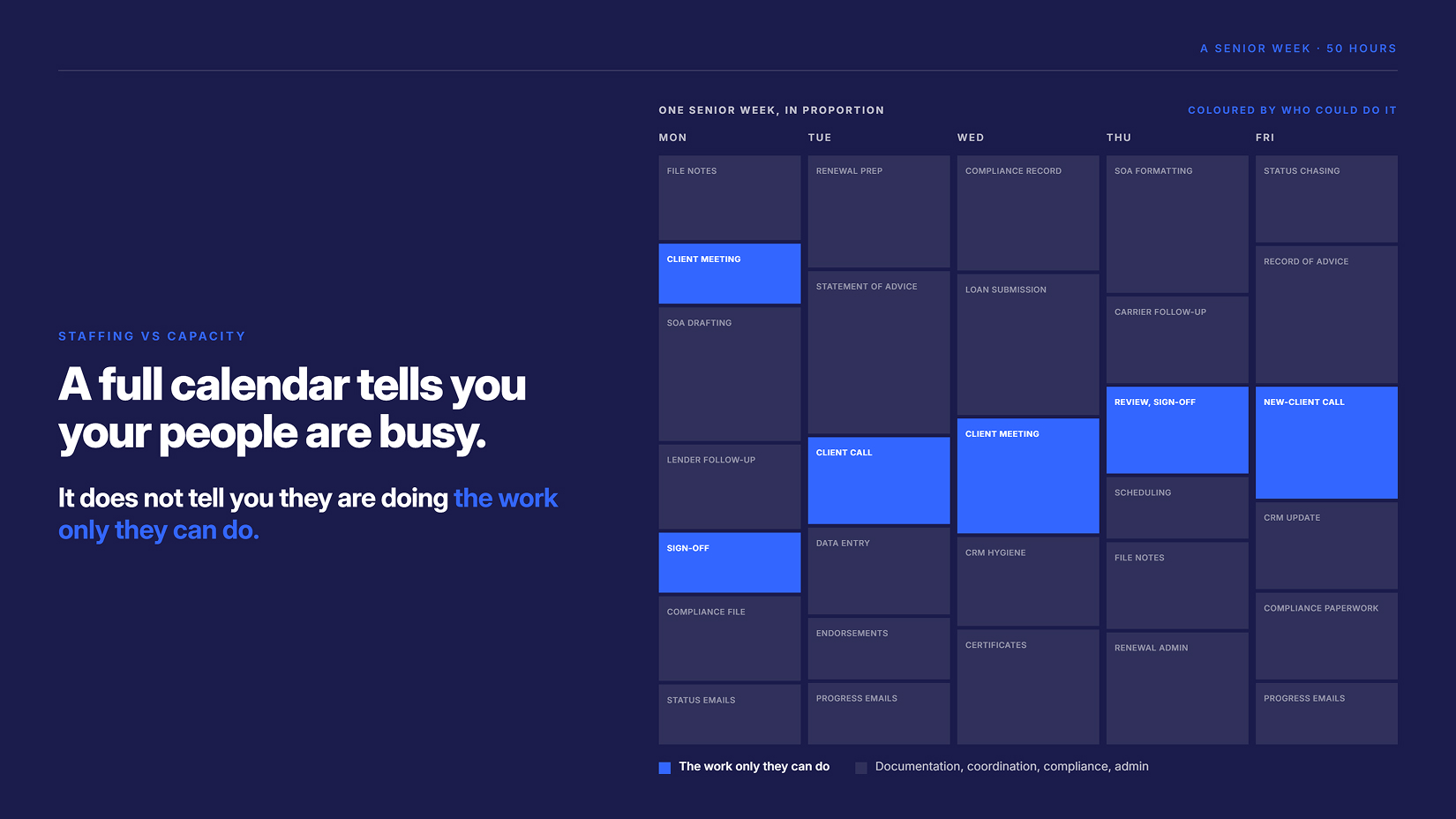
A full calendar tells you your people are busy. It does not tell you they are doing the work only they can do.
Close the opener with a promise: this piece will show you where senior time actually goes in advisory firms, what the pattern looks like across accounting, advice, broking and insurance, and how to measure the split instead of guessing at it.
A staffing problem says you do not have enough people to do the work. A capacity problem says you have the people, but the work has been allocated so that your most expensive hours land on the tasks anyone could do. Only one is solved by hiring.
Busy is a signal, not a result
Argue: utilisation is a measured concept, not a mood. Realisation benchmarks in accounting firms show billed value routinely trails worked value (Intuit/Rosenberg, US, labelled). Utilisation targets fall with seniority; partners are expected to convert the least of their time to billable value, because the scarcer the senior hour, the more its misallocation costs. Land the reframe:
Utilisation measures how busy your people are. It says nothing about whether the busiest hours are the valuable ones.
Bridge into the Australian and international evidence.
Where the senior hour actually goes
Lead Australian, then widen.
Australia, financial advice: the initial advice process runs to 23.9 hours per client (KPMG for the FSC). Of that, 5.5 hours goes to writing a single Statement of Advice (FAAA, Sarah Abood). Land the hero image:
Your most qualified adviser can spend more than five hours documenting one piece of advice. The judgement was the first hour. The rest is paperwork that carries their salary but not their expertise.
Australia and international, general advice: Kitces (US, labelled) finds advisers spend no more than about half their week on client-related work, and barely a fifth actually meeting clients. The calendar is full. The client work is a sliver.
Accounting firms: most of the week goes to compliance and processing, and senior people are the ones doing it (Intuit / Rosenberg, US, labelled).
Mortgage broking (Australia): 15 to 40 hours per loan, with much of it processing rather than judgement.
Insurance: licensed revenue work sits alongside repeatable admin (renewals, endorsements, certificates, follow-up).
The pattern repeats across every advisory sub-sector. One firm looks like an anecdote. Five sub-sectors is a category truth.
What only they can do, versus what someone else could
Split the senior week into two lists.
Only they can do it: professional judgement on strategy (the actual advice, structuring, tax and risk calls); client relationships and difficult conversations; complex or non-standard case decisions; sign-off and quality control that carries the licence; new-client conversion.
Someone else could do it (onshore or offshore): drafting and formatting documentation (Statements of Advice, Records of Advice, file notes, loan submissions); data entry and CRM hygiene; coordination and status-chasing (lender follow-up, carrier follow-up, progress emails); compliance record-keeping (not the judgement, the paperwork that documents it); renewal prep, endorsements, certificates; meeting scheduling.
Close the section: the goal is not to replace local senior people. The goal is to free them to do the expertise-dependent work.
Comparison table (Hire vs Reallocate)
Why the leak survives
Argue: busyness is easy to see. Value is easy to miss. Every firm has an implicit belief that if the senior calendar is full, the expensive time is being spent well. That belief protects the leak.
Add the felt-experience layer: the senior person doing five hours of typing looks productive; the firm looks efficient; the partner reports on a busy week. Everyone is behaving reasonably. Nobody has looked at the actual split.
Land the reframe:
A busy senior specialist is not proof the expertise is being used. It is often proof it is being buried.
Measure before you hire
Kitces (US, labelled) finds 3 to 6 weeks of activity tracking is enough to see the split clearly. Most advisory firms have never done it. J.D. Power (US, labelled) finds time-poor advisers spend 41 percent more time on non-value-added tasks. The reallocatable share is almost always bigger than firms expect.
Introduce the Activity Analysis Session as the low-friction first step:
Free, one-hour, consultant-led discovery discussion.
Not an audit. Not a savings quantification. Not a productivity guarantee.
Surfaces which activities in the senior week are remote-capable and shows cost-differential ranges.
Deliberately the first hour of looking. The quantified total savings sit in the separate CMO Evaluation, which is a paid engagement.
Position it as discovery, not diagnosis with a verdict. The point is to see, not to sell.
Five signs your senior people are doing low-value work
Your most qualified people spend more than half their week outside client meetings.
Statements of advice, loan files or reports are written by the person who signed them off.
Compliance evidence is assembled by the person whose judgement is being documented.
Follow-up emails, status chases and CRM updates land on partner or principal calendars.
You cannot say with confidence where last week's most expensive hour was spent.
New Zealand: the same pattern, less measurement
Handle NZ explicitly. New Zealand does not yet have a public Advisory time-use dataset comparable to KPMG/FSC or FAAA. The FSLAA/FMA regulatory reality (mandatory adviser disclosure, ongoing regime obligations) makes the compliance workload visible without necessarily quantifying it. IRD's 6,700 audits in 2025 (up 26 percent year on year) increases the value of clean senior review time.
Do not attach Australian hours figures to New Zealand. Argue the pattern instead: the Australian evidence, the international evidence, and the shape of the New Zealand regulatory environment all point in the same direction. The measurement question is the same one. The answer is not borrowed; it is measured.
Close: the honest New Zealand play is to look, not assume.
What the calendar cannot show you
Argue: a calendar shows blocks. It does not show whether the block was expertise, coordination, documentation or admin. It does not show which of the hours in a client meeting were judgement and which were logistics. It does not show whether the reply to a lender email needed the partner or would have been fine from the associate.
The gap between what the calendar shows and what the week actually does is the whole territory this article is arguing about.
Bridge to close: measuring the split is the first move. Everything else - hiring, automating, offshoring - is a downstream decision that depends on knowing
Close
Do not open with "in conclusion." Close on the anchor line and the offer.
You do not have a staffing problem. You have a work allocation problem. Most advisory firms do.
The Activity Analysis Session is the first hour of looking. It is free, one-on-one with an Outrun consultant, and produces a view of which senior activities are remote-capable and where the cost-differential ranges sit. It is not an audit. It is not a savings quantification. It is deliberately the smallest possible next step from where you are today.
Find your Activity Analysis Session at https://outrun.global/activity-analysis-sessions.
Company channel Bitly for this blog: https://go.outrun.global/4gVZu43
FAQ
Do we have a staffing problem or a capacity problem? A staffing problem says you do not have enough people. A capacity problem says the work has been allocated to the wrong people. Most advisory firms discover a capacity problem the moment they look; the fix does not always require hiring.
Where does a senior adviser's or partner's time actually go? Kitces (US) finds advisers spend no more than about half their week on client-related work and barely a fifth actually meeting clients. In Australian financial advice, KPMG for the FSC reports 23.9 hours per client for initial advice, of which 5.5 hours is writing the Statement of Advice.
How can we scale an advisory firm without hiring? Measure where senior hours are landing today, split the week into work only they can do versus work someone else could do, then move the second bucket. Reallocation, remote capacity, or automation each become options once you can see the split. Hiring is one option, not the default.
What is an Activity Analysis Session and how long does it take? A free, one-hour, consultant-led discovery discussion. It surfaces which activities in your senior week are remote-capable and shows cost-differential ranges. It is deliberately not an audit and does not quantify total savings; the CMO Evaluation is the separate paid engagement that produces that.
What is hidden capacity, and how would we know if we had it? Hidden capacity is senior-level hours currently absorbed by work that does not require senior-level expertise. You would know you had it if, when you measured, you could not defend more than half of your most expensive people's calendar as work only they can do. In our experience with advisory firms, most cannot.

Explore more categories
Partner Resources
Read the Full Guide
The New Zealand and Australian Accountant's Guide to Advising on Offshore Solutions are the 20-minute and 30-minute companion resource covering the complete regulatory framework, cultural navigation, liability management, and conversation methodology. The toolkit extracts the practical tools from that guide.
Get fresh cost saving tips & insights, monthly
Unsubscribe anytime

Outrun places admin professionals in the Philippines with New Zealand and Australian businesses, so the people you already employ get their week back for the work you hired them for. We employ them, pay them and run their HR. You manage the work.
2026 © Outrun.global | Privacy Policy | Term of Service | Acceptable Use Policy | Data Processing Addendum | Modern Slavery Policy