
Resources
FY27 Starts Lighter: How to Hold the Cost-to-Activity Reset You Made in June
By the time most Australian business owners read about the new financial year, the advice has already arrived in the same shape it arrives in every July. Update your payroll tables. Lodge your finals. Confirm the modern award rise. Brief the bookkeeper on Payday Super. The headlines treat 1 July 2026 as a compliance event. They are right that it is one. Modern award minimum wages rise by 4.75 per cent. The National Minimum Wage rises by 6 per cent to $1,004.90 a week, or $26.44 an hour. Payday Super starts, and superannuation now leaves the business inside seven business days of every pay run, not once a quarter.
The compliance work is real. It is also not the question that matters most this week.
The question that matters most is one almost no one is asking in the first week of FY27. What cost base did you bring into this year, and how do you hold it where you set it? Because the cost base you carry today is the cost base you keep, unless you decide otherwise now.
This piece is about that decision. It is the new financial year cost review the field has not written.
What to do in the first week of FY27 (after the EOFY rush)
The behavioural research on temporal landmarks is unusually clean for a marketing claim. Dai, Milkman and Riis (2014) tracked Google search activity for goal-related terms across multiple US cohorts and found that searches relating to commitments rose by about 145 per cent on the morning after a new year boundary. People do not just feel that the start of a year is a good time to act. They actually act. The follow-on work matters more. Norcross (2002) tracked the durability of those decisions and found that 46 per cent were still being kept at six months, against 4 per cent for an equivalent mid-year cohort.
We are applying an individual-behaviour finding to a business setting by analogy, not by direct measurement. The honest reading is that boundary-anchored decisions are easier to start and easier to sustain. They sit inside a moment the whole business is already braced for. The bookkeeper expects payroll changes. Finance has already opened a new financial year in the ledger. Staff have been told it is FY27.
That is the moment where a cost decision holds best. The same decision made in October, when nothing else is resetting, becomes one more change to fit into a working week that has stopped resetting. It does not stick the same way.
So the answer to "what should I do in the first week of FY27?" is not "wait for things to settle". It is the opposite. The settling itself is the asset. Use it.
The standing risk with the fresh-start frame is that anticipating a landmark can license deferral. The owner who tells themselves they will deal with costs once they have got through July ends up dealing with them in September, then October, then never. The frame works the other way only if 1 July is treated as the moment to act and lock in. Not the moment to begin planning to act later.
How to review your business costs at the start of the financial year
A cost review at the start of a financial year is not the same as a budget cycle. The budget is set against the cost base. The cost base is the thing the budget is set against. If the cost base is wrong, no amount of careful budgeting fixes it.
Here is the shape of a useful review in the first weeks of FY27.
List the activities, not the roles. Most cost reviews start with the org chart. That gets you to "could we lose a head?" which is the wrong question and the answer to which is almost always no. The right starting point is the activities those roles are running every week. Each role is a bundle of activities, some remote-capable, some not, some matched to the cost they sit at, some not.
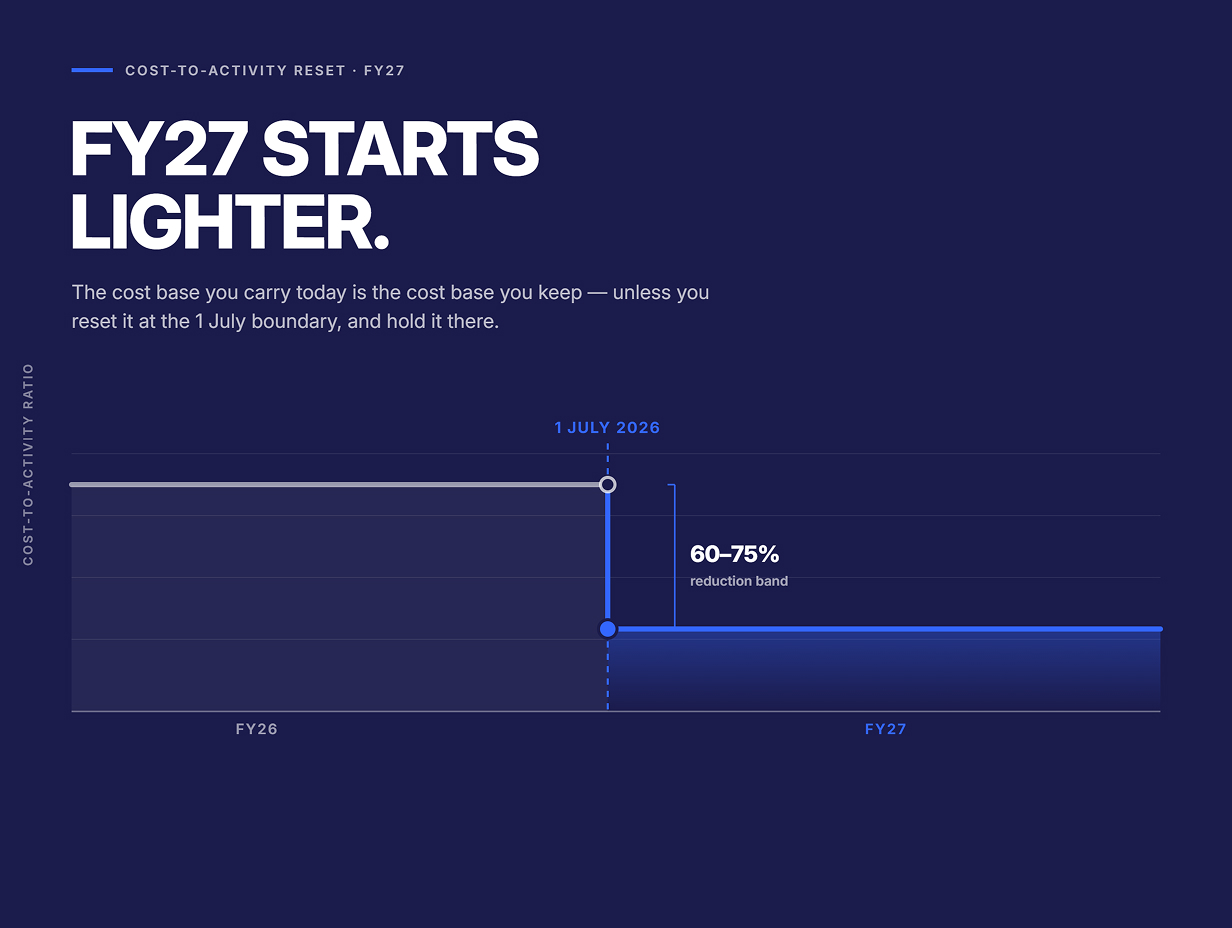
Mark which activities could sit at a different cost. Across the activity bundles, identify the remote-capable work that does not need to be done from inside an Australian office at an Australian salary. This is where the validated 60 to 75 per cent cost reduction band on remote-capable activities sits as an output, not as a slogan. The band is the result of an activity analysis, not a promise made up front.
Cost the current setup honestly. Loaded labour cost, not the salary line. Software the role uses. Office overhead allocation. Manager and reviewer time the activity consumes. Most reviews stop at salary; salary alone understates a role's cost by anywhere from 15 to 30 per cent.
Pick a single activity bundle to move first. Not the whole role. Not the whole function. One bundle. The one with the cleanest seams, the lowest customer-facing risk, and the highest weekly hours.
Set the criteria for "it holds". Quality criteria, output cadence, error tolerance, the review pattern. Without this, you reshape the cost and lose the standard, and the work creeps back into the role within three months.
Match the offshore build to the activity, not the headcount. Hiring a "VA" or a "junior" is the wrong frame. The offshore staff member is matched to the activity bundle, trained on the tools the activity uses, and held to the criteria you wrote down in step five.
Review on a fixed cadence, not when the pressure rises. Monthly for the first quarter, then quarterly. The cadence is what stops drift back, which is the failure mode most often reported in the cost-transformation literature.
That list is the start of financial year cost review done correctly. It is also the path that the Activity Analysis Session is built to compress into a one-hour conversation, which is where most owners enter the work.
Why the start of the year is the moment to review your operating model, not just your budget
There is a difference between an activity reshape and an operating-model question, and FY27 is when that difference shows up cleanly.
An activity reshape is a tactical move. You take a bundle of activities sitting inside a role, send the remote-capable portion to a dedicated offshore team member, and keep the customer-facing or judgement-heavy portion in the local seat. The role is preserved. The cost base falls. The org chart looks the same.
An operating-model question is structural. It is not "could this activity sit at a different cost?" but "is the model around this set of activities still the model the business needs?". Bain has published reasonably consistent work showing that companies whose operating model is set up to compound with their strategy grow revenue about 120 basis points faster and run margins about 260 basis points higher than those whose model lags. Only about one in five executives in their survey work say the model itself is a competitive advantage rather than a constraint.
The signal that you have an operating-model question, not an activity reshape, is usually one of three things. The cost reshape you made in June feels structurally wrong already, not just under-finished. The activities you most need to move are the ones you cannot move without rethinking the role they sit inside. Or the same cost pressure you reshaped at EOFY is already returning, because the model around the activities has not changed.
If any of those applies, the right move in the first week of FY27 is a CMO Evaluation. That is a paid, low-entry diagnostic that produces a quantified picture of which costs are activity-shaped and which are model-shaped, with the offshore execution path built into the recommendation rather than added later.
The blog you are reading has its CTA on the Activity Analysis Session. That is the right surface for a "review what you have, fast" entry point. The operating-model question is a different surface, and Wednesday's Company Page post on Outrun's LinkedIn is the right place to find that thread.
Lowering your cost base by activity, not by headcount
The default move in a cost review is to ask whether a role could go. It is the move accountants get asked for, the move CFOs are trained to model, and the move boards expect. It is also a poor instrument for the question almost every business actually has.
The question businesses have is "how do we carry less cost without losing the work?". The answer to that is rarely "lose a person". It is almost always "rearrange where the activities sit".
There are about ten to twelve discrete activities inside most operational roles, give or take the function. Of those, the share that is remote-capable runs from about 40 per cent in customer-facing roles to about 80 per cent in finance, marketing operations and administrative roles. That share is the lever. It is also the lever competitor copy in the offshore field rarely names, because the field has been trained to sell roles, not activities.
The implication for the FY27 cost base is direct. A 70 per cent share of remote-capable activities, moved to a dedicated offshore team member, costs in the 60 to 75 per cent reduction band on those activities. That is a measured output of a real activity analysis with a comparison-basis qualifier, not a marketing percentage. The headline number you see on offshore-staffing websites this week is not a fact about your business. It is an average across businesses that may or may not look like yours.
The execution risk that justifies the deferral most owners feel right now is real, and is the reason the 180-day re-recruitment guarantee exists. The market norm for offshore replacement guarantees clusters at 30 to 90 days. The Outrun guarantee is 180 days, free, no reason required. It is roughly six times the most common industry standard. It is not framed as a performance promise. It is framed as risk transfer at the point in the year when commitment fear is highest, which is now.
What "holding the reset" means
A reset is the easy word. The work is the holding.
Hold here means three things working together.
First, the activities are documented somewhere other than in the head of the person who used to do them. The handover artefact is the asset. Without it, the offshore team member is recruited into a job that exists only as a verbal expectation, and the cost reshape becomes contingent on a single individual not leaving.
Second, the criteria for "good enough" are written and reviewed. Output cadence. Quality threshold. The frequency at which a manager reviews. The escalation path. These keep the reshape from sliding back to the local seat when the first quality scare happens.
Third, the cadence of review is non-negotiable. Monthly for the first quarter, quarterly after that. Not "we will check in if there is a problem". A diarised review keeps drift visible while it is still small enough to fix.
A reset that holds all three is a reset that compounds. It carries through July, lands in August, and is invisible by October, which is the moment most "structural change" disappears. The reset that does not hold all three is the reset that the literature on cost-cutting describes when it reports that most reductions revert in one to two years. Bain has put the revert window at one to two years for one-off cuts; BCG has put the transformation failure rate at about 75 per cent; McKinsey has tracked roughly one in four cost programmes still in place at four years. The numbers vary; the direction is consistent. Cuts revert. Structural reshapes hold.
The temptation in early July is to declare the reset done and step away from it. Liebman and Mahoney's 2017 work on fiscal-year-end spending behaviour is the warning. Year-end spending runs at about 4.9 times the rest-of-year weekly average, and end-of-year projects are about 2.2 to 5.6 times more likely to score below median quality. Whatever you did in the last two weeks of June, the first two weeks of July are when the holding work happens. Not the celebration of having done it.
A note on New Zealand
The temporal argument in this piece is specific to the Australian financial year. New Zealand's financial year ended 31 March 2026 and the next one starts 1 April 2027, so 1 July does not carry the same fresh-start mechanic. The activity-level cost-to-activity argument carries across both markets and is the layer New Zealand businesses can lead with. The deadline framing is not.
The first move
You do not need a project, a consultant, or a quarter of preparation to start. You need an hour and one number.
The Activity Analysis Session is one hour, free, with a consultant. It looks at a function or role you are willing to bring into the conversation, and at the end you leave with two things you did not have at the start. The list of remote-capable activities inside that role, and the cost band the reshape would land in. Not a report. Not a pitch. Two answers.
If after that hour the answer is "this is an operating-model question, not an activity reshape," the next move is a paid CMO Evaluation. If the answer is "this is an activity reshape," the path forward is documented, the offshore build is matched to it, and the 180-day guarantee covers the recruitment risk.
The first week of FY27 is the cheapest time all year to make that move. The base you set this week is the base you carry. Make it the one you would set deliberately.

Explore more categories
Partner Resources
Read the Full Guide
The New Zealand and Australian Accountant's Guide to Advising on Offshore Solutions are the 20-minute and 30-minute companion resource covering the complete regulatory framework, cultural navigation, liability management, and conversation methodology. The toolkit extracts the practical tools from that guide.
Get fresh cost saving tips & insights, monthly
Unsubscribe anytime

Outrun places admin professionals in the Philippines with New Zealand and Australian businesses, so the people you already employ get their week back for the work you hired them for. We employ them, pay them and run their HR. You manage the work.
2026 © Outrun.global | Privacy Policy | Term of Service | Acceptable Use Policy | Data Processing Addendum | Modern Slavery Policy