
Resources
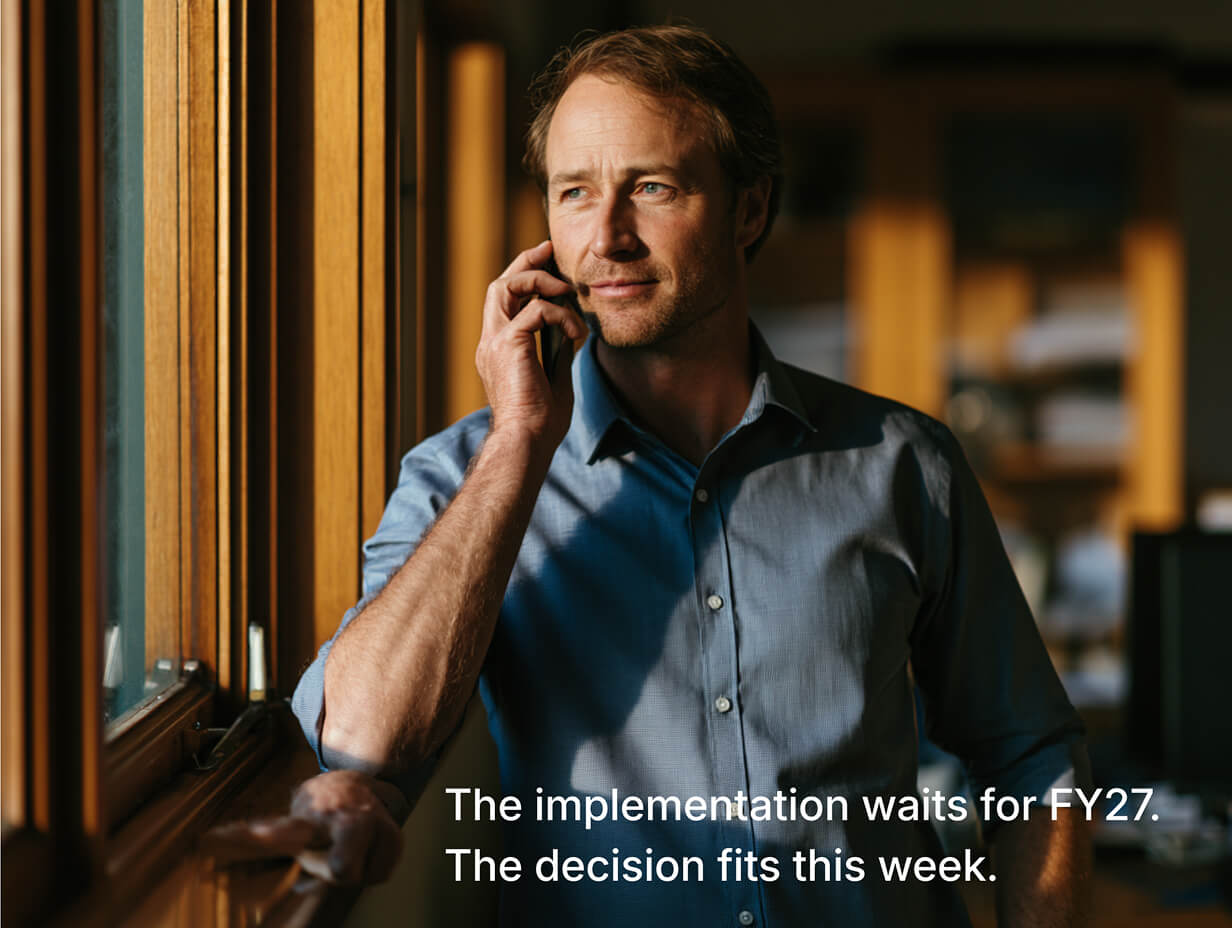
The Last Full Week Before EOFY: The Reshape Step That Still Fits Before 30 June
For the last full business week of the financial year, the same question lands on Australian owners and CFOs every morning. Is it too late to cut costs before 30 June, or has the window already closed? Most advisers will tell you the tax levers are the only thing left, and they are right about the tax levers. They are simply silent on the other thing that locks in on 1 July. Your operating cost base hardens at midnight on 30 June. The decision about what shape it carries into FY27 still fits inside this week.
1. The last full week before EOFY: what is still on the table
For most cost-base questions, the answer in late June is honest and uncomfortable. You cannot recruit, onboard and place an offshore team member before 30 June. The independent offshore field talks in four-to-eight-week ranges from decision to placement, with productive ramp closer to ninety days. A reshape decided this week places its resources in FY27 Quarter 1, not before midnight on Tuesday 30 June.
So what does fit inside the window? Two specific things.
The first is a free, one-hour, consultant-led Activity Analysis Session. It is bookable this week, runnable this week, and produces an answer the owner walks away with. It surfaces the activities sitting inside a role that could move to a lower-cost surface, and the cost differential against the seat that is carrying them today.
The second is the task savings calculator. It is a ten-minute self-serve step. You feed it the activity mix you already have, and it produces a percentage and dollar estimate against publicly available Australian and New Zealand salary benchmarks. No meeting, no budget, no commitment.
The decision and the first step fit the window. That is the entire claim this article is built on. We are not going to suggest you can hire a finished team before next Tuesday.
2. Why the FY27 cost base hardens at 30 June
Last week, this publication argued the cost base is decided before 30 June, not after. The mechanism is straightforward. On 1 July 2026, modern award minimum wages rise 4.75% effective the first full pay period on or after that date (Fair Work Commission Annual Wage Review 2026 decision, handed down 2 June 2026). The rise applies to whatever activity mix is sitting inside each role on the first pay run of FY27. Reshape afterwards and the entire first quarter is priced on the pre-reshape base.
That mechanism does not care whether the deferral was deliberate or unintentional. It does not soften because the owner was busy with tax planning. The pricing rises on the activity that is in the seat at 1 July, not on the activity that gets moved later. That is what makes the cost base hard at midnight on 30 June.
The piece this article adds is a feasibility one. The deadline is real, and the first step still fits inside it.
3. The one activity-level reshape step that still fits before 30 June
The crowded advice this week is to act on the tax levers. Maximise super contributions before 30 June. Prepay expenses. Use the instant asset write-off. Review trust distributions. Australian accounting and wealth voices have published variations on that checklist all month, and they are correct on the tax substance of it.
What none of them addresses is the cost-base question. The single activity-level reshape step that fits the window has three parts: a free Activity Analysis Session that runs inside the week, decomposition of one role into its constituent activities, and identification of the activities that could move to a lower-cost surface. After that, the placement work begins, and runs into FY27. But the decision, the first step, the question of what your FY27 cost base is going to look like, all of it locks in this week.
4. What you can actually change in the last full week before EOFY
The ordered list below is the concrete set of moves that fit inside 22-30 June. Each step is single-action and discrete.
Book the free Activity Analysis Session. One hour, consultant-led, no cost, no obligation.
Pick one role. The owner is in the best position to identify the role where the most expensive seat is carrying the most low-value activity.
List the activities sitting inside that role. The decomposition is the work; the list is the artefact.
Mark the activities that are remote-capable. Remote-capable is a property of the activity, not the person.
Identify the cost differential. The Activity Analysis Session shows the cost ranges; it does not generate a full quantified report. That is the boundary between this free first step and a deeper engagement.
Decide. The decision is what locks the FY27 cost base. The placement work runs over the four-to-eight weeks that follow.
Run the task savings calculator alongside. Ten minutes, self-serve. Produces a percentage and dollar estimate for the cost differential identified.
The visible work for the owner is steps 1 to 6. Step 7 is the parallel self-serve track that informs the conversation.
5. What an activity analysis session is (and what it produces)
An activity analysis session is a free, one-hour consultant-led conversation that maps a business's actual activities to find work that could be handled offshore at a lower cost. It produces identified opportunities and cost ranges, not a formal report. It is delivered at no cost and carries no obligation to proceed.
What it deliberately does not do is generate a full quantified savings number. That work belongs to a deeper engagement (the CMO Evaluation), and it does not fit in one hour. The activity analysis session is the first step. It is the step that produces enough clarity for the owner to decide whether to take the next step.
6. How long does an activity analysis session take?
One hour. That is the entire commitment. Booking lead time is typically inside a week during normal business cycles. Both the booking and the session itself fit inside the 22-30 June window.
7. The 1 July 2026 stacking deadlines that make this time-sensitive
There are two changes landing on 1 July 2026 simultaneously. The first is the 4.75% modern-award rise covered in section 2. The second is Payday Super.
From 1 July 2026, employers must pay superannuation every payday, with contributions received by the employee's fund within seven business days of each payday (twenty business days for a new employee's first contribution). The quarterly super cycle is gone. Treasury Laws Amendment (Payday Superannuation) Act 2025 (Royal Assent 6 November 2025) is the legislative source. ATO, APRA and Fair Work Ombudsman confirm the 1 July 2026 commencement with no transition period.
The working-capital implication is direct. The quarterly super float disappears; superannuation now leaves the business almost in lockstep with wages. For a CFO or financial controller, that is a cash-flow-timing change separate from the cost-base change. They stack on the same date but they are different mechanisms.
The Small Business Superannuation Clearing House closes to existing users on 30 June 2026. Note that the broader public commentary on 1 July also includes the National Minimum Wage rise, which was approximately 5.97% (the move from $24.95 to $26.44 per hour). The 4.75% applies to general modern-award minimums; the 5.97% applies to the NMW specifically, with the C13 structural adjustment driving the difference. Do not blend the two percentages.
8. After 30 June: what shifts from reshape to repair
After midnight on Tuesday 30 June, the FY27 cost base is set. Reshaping after 1 July does not avoid the award rise. The award rise has already taken effect, and it has been applied to the activity mix that was in the seats. Reshaping in July still produces savings on the activities that move, but the first quarter of FY27 is already priced on the heavier base.
The shift between 30 June and 1 July is not absolute. It is the shift from reshape to repair. Both are legitimate. Repair simply costs more.
9. Book the final-window activity analysis session
The Activity Analysis Session is free, one-hour, and consultant-led. It identifies opportunities and cost ranges. It produces no obligation to act. It is the step that fits inside the 22-30 June window. The placement work, if you decide to proceed, runs into FY27.
The 180-day guarantee removes the obvious objection. If a placed staff member leaves or does not work out within the first six months for any reason, Outrun re-recruits at no additional fee. No reason required. That is six times the thirty-day minimum that many providers offer, and approximately double the ninety-day mark that is as close to a standard as the industry has. It is a re-recruitment guarantee, not a performance or productivity guarantee. It comfortably spans the typical ninety-day ramp plus buffer.
Book the free Activity Analysis Session.
10. Can you still cut costs before 30 June?
Yes. You can decide. You can take the first step. You cannot finish the implementation. The decision is what locks the FY27 cost base, and the decision still fits inside this week.
11. Is it too late to reshape before the end of financial year?
It depends on what is meant by reshape. The decision and the first step still fit. The placement work runs into FY27. If reshape means the implementation is done by 30 June, then yes, that window has closed for new starts. If reshape means the FY27 cost base reflects a decision made before 30 June, then no.
12. Is one week genuinely enough to make a meaningful change?
One week is enough to make the decision that locks the FY27 cost base on a different shape. It is not enough to install offshore staff in seats. Treat one week as enough for what it is actually enough for.
Free Activity Analysis Session. One hour. Consultant-led. Zero markup on salaries. 180-day re-recruitment guarantee. Book before 30 June.

Explore more categories
Partner Resources
Read the Full Guide
The New Zealand and Australian Accountant's Guide to Advising on Offshore Solutions are the 20-minute and 30-minute companion resource covering the complete regulatory framework, cultural navigation, liability management, and conversation methodology. The toolkit extracts the practical tools from that guide.
Get fresh cost saving tips & insights, monthly
Unsubscribe anytime

Outrun places admin professionals in the Philippines with New Zealand and Australian businesses, so the people you already employ get their week back for the work you hired them for. We employ them, pay them and run their HR. You manage the work.
2026 © Outrun.global | Privacy Policy | Term of Service | Acceptable Use Policy | Data Processing Addendum | Modern Slavery Policy