The Team Behind the Team: How Offshore Adds Capacity for New Zealand Businesses
What does it mean when an offshore team is an enabler and not a replacement? An offshore team is an enabler when it adds capacity to the people you already have, taking on repeatable and remote-capable work so your most experienced staff spend more of the week on the judgement, relationships and decisions only they can make. It is a replacement when a role is removed and refilled offshore. Those are different decisions with different outcomes.
Where does your most experienced person's week actually go? Most owners cannot say. When advisers in the United Kingdom measured, only about a third of the day was reaching clients. When Australian financial advisers measured a Statement of Advice, roughly nine of the fifteen hours were structured activity that did not require the licensed person. You cannot reallocate what you have never looked at.
How much does in-house tax compliance cost a New Zealand business? Inland Revenue's 2024 measurement found the median New Zealand business spends thirty-two hours a year on in-house tax compliance, with an average closer to seventy-seven hours and a combined compliance cost of about NZ$5,665. That is before the chasing, coordinating and re-keying that surrounds it.
The Team Behind the Team: What Capacity Really Means When Offshore Is Done Right
The conversation is playing in more New Zealand boardrooms than it did a year ago, and it usually starts the same way. An owner wants growth. Their most experienced people are already working long weeks. Local hiring has been slow, when it has moved at all. The instinct is to add another local seat. The problem is the seat that would help is the one that already exists. It is just full of work the person in it was never meant to be doing.
Jarra Borman and Paul Spain sat down to talk about this on the NZ Business Podcast. The episode is titled around the future of work, and Paul Spain treats artificial intelligence and augmentation as the macro story. Jarra sits underneath that story with the operator and measurement question. If capacity is the goal, the honest first move is not to buy more people or plug in more tools. It is to look at where the hours already go, and to add the right kind of capacity for the work that should not be sitting on the wrong desk.
Listen to the full conversation on the NZ Business Podcast here.
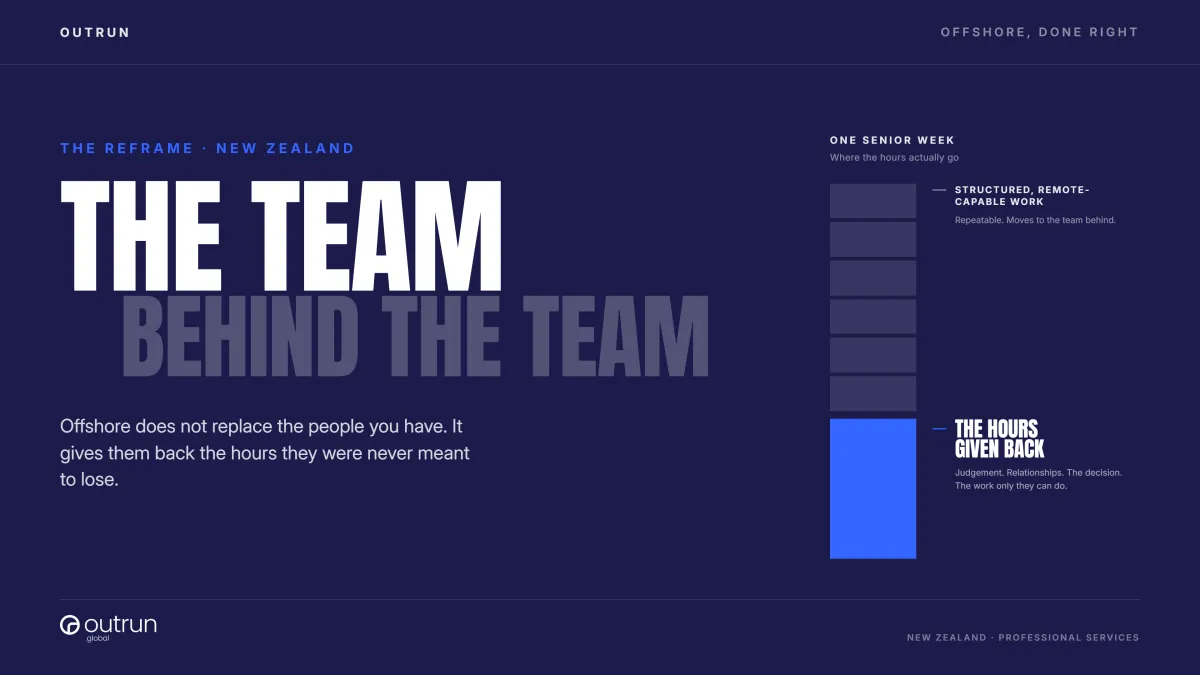
That is the reframe this blog carries. Offshore, done well, does not replace the people you have. It gives them back the hours they were never meant to lose.
Does offshore staffing replace your local team?
No. When it is set up as an enabler, it does the opposite. A dedicated offshore team member is a structural addition. They are directed by you, join your workflow, and work only for your business. Repeatable and remote-capable activity moves to them. The judgement, the client relationships and the decisions stay where they belong, with your senior local people. In practice, that means the licensed person in a New Zealand firm signs off the advice, holds the compliance responsibility and owns the conversation with the client. The structured work behind that outcome sits with a team member who is trained to your standards but whose seat costs less to run.
That is a design decision, not a headcount decision. It looks nothing like a role redundancy, because nothing has been removed. It looks nothing like a freelancer arrangement, because time is not split across other clients. It looks nothing like a project vendor, because the work is not being handed over as a scope of work.
Why does the language matter?
Because the language around offshore has been contested for a decade, and the buyer-side fear that offshore means fewer local people has been earned. It has been earned by cost-first pitches that led with headcount reduction, by contractor arrangements that felt transactional, and by project models where accountability disappeared once the scope closed. It is fair, in that sense, that the reframe has to work harder to be heard.
The clearest way through is to stop asserting the slogan and to show the three legs the reframe rests on. First, the offshore team member is employed, not contracted. That is the structural difference from a freelancer. Second, the work they take on is chosen by activity-level design, not by cutting a role in half. That is the structural difference from a cost-cutting programme. Third, a named person is accountable for how the reallocated work runs, which is the structural difference from a project handover. Any offshore arrangement that has all three is doing something different from the offshore arrangements that gave the word a bad reputation. Most do not have all three.
Where does your most experienced person's week actually go?
This is where the conversation with owners tends to turn from theory to something more useful. Ask most owners where their senior person's week went, and the honest answer is a shrug, then a story about a big client, then a shrug again. It is not that owners do not care. It is that a busy week does not label itself as it goes. It just goes.
The evidence from firms that stopped guessing is consistent. When Fidelity's research team in the United Kingdom looked at where adviser hours went, only about a third of the day was reaching clients. When the Australian financial advice sector measured the effort behind a single Statement of Advice, the figure landed around fifteen hours of work with roughly nine of those hours in structured activity that did not require the licensed person. In the accounting industry, a repeated pattern is that once compliance activity moved out, the practice reported that senior hours redirected toward advisory conversations. The numbers travel with a country label attached, because different markets measure different things. What travels between markets is the direction. Where firms actually look, the senior week is a mix of high-value work and structured work, and the structured share is larger than the owner expected.
New Zealand does not yet have a public measurement of the professional-services senior week. What it does have is Inland Revenue's 2024 tax-compliance data, which tells a directional story. The median New Zealand business spends thirty-two hours a year on in-house tax compliance, and the average is close to seventy-seven hours, with a combined cost of about NZ$5,665 per business. Those are hours of somebody's week. In smaller firms they are often the owner's hours or the senior partner's. In larger firms they sit with the team the owner would rather have on client-facing work.
Why is this a demand question in New Zealand?
Because the alternative is not a real alternative. Local hiring is barely moving in New Zealand. In CPA Australia's 2025 survey of New Zealand small businesses, only about seven percent grew their headcount in the previous year. Chartered Accountants Australia and New Zealand reports fill rates below sixty-seven percent for the roles most likely to be reallocatable, and the New Zealand Financial Markets Authority reports that half of the country's financial advice providers now operate as a single-adviser business. In practice, the New Zealand owner asking whether to add capacity is often asking a question the local labour market cannot answer.
That does not make offshore a foregone conclusion. It makes measurement the honest first step. If a senior person's week is mostly high-value work already, adding offshore capacity is either premature or misplaced. If the same week contains a large share of structured activity, offshore capacity is exactly the lever that could give the senior person their time back without asking the labour market for a favour it cannot grant.
What actually changes when it works?
The change is not usually dramatic in week one. It is a change in the shape of the week over a few months. The owner reports fewer late nights. The senior partner reports more client conversations that end in a decision instead of a rescheduled call. The compliance work still lands on time, but it does not land in the last thirty minutes of a Friday. In accounting firms, once repeatable compliance activity has moved to a dedicated offshore team member trained to the firm's standards, industry surveys show a high share of firms reporting they grew because the licensed people had the room to grow. In Australian advisory, providers report reclaimed capacity translating into more clients served per adviser per year. Those are pattern-level observations, not universal outcomes.
There are two ways to lose the outcome. The first is treating offshore capacity as a cheap contractor pool. That is the freelancer trap. The second is treating offshore as an efficiency programme that is judged on hours removed rather than hours reallocated. That is the cost-cutting trap. The teams that get the enabler outcome treat the offshore hire the same way they treat a local hire. They onboard properly, they set the standard, they measure the activity, and they keep the accountability with a named person on their side of the arrangement.
How do you measure where senior staff time goes?
You start with an hour of looking. An Activity Analysis Session is a free, one-hour, consultant-led discussion that maps the activities inside a role and separates the ones that require the senior person from the ones that only feel like they do. It is a discovery discussion, not a productivity report. It shows where the week is going. That is enough to move the conversation from a headcount question to a design question. From there, a firm can decide whether the answer is a reallocation inside the existing team, an offshore addition, an AI-supported change to how a specific activity is done, or a combination.
The design question sits above the AI question and above the offshore question. AI is powerful when it is deployed against structured activity that a human should not be doing. Offshore is powerful when the reallocated activity is remote-capable and repeatable. Both are consequences of the design decision, not substitutes for it.
What does cost have to do with it?
Cost is a proof point, not the reason. The buyer decision, when it works, is a design decision that also happens to be cheaper. The savings that show up when an offshore team member takes on remote-capable activity typically sit in a sixty to seventy-five percent band relative to the local cost of the same role. Those savings are based on a comparison of Outrun versus local hiring costs for the same role. They are a cost comparison, not a measure of output. Presenting them as anything else is where offshore providers historically lost the buyer's trust, and it is a boundary we hold.
What is the risk if you get it wrong?
The risk is not that offshore fails. The risk is that a firm buys offshore capacity without doing the design work first, and the capacity lands on the wrong activities. The senior person keeps doing the structured work because the offshore role was set up around the wrong tasks. The offshore role costs less than a local hire, so the firm reports a saving, but the capacity outcome, more senior time on the work only they can do, does not arrive. Two years later, the firm concludes offshore did not work. It is not that offshore did not work. It is that offshore was asked to solve a design problem that had never been surfaced.
That is why the honest first step is not a proposal. It is a look. The Activity Analysis Session exists for exactly that. It is free because it is the first step, not because it is loss-leading. You cannot reallocate what you have never looked at.
What is the smallest useful step from here?
If any of this reads like your firm, the smallest useful step is not a business case. It is one conversation, one hour, focused on a single senior role. A senior partner, a lead designer, a principal adviser, a general manager. Someone whose week is worth a closer look because the cost of getting it wrong sits on their calendar. Book the Activity Analysis Session for that one role. If the discussion surfaces a shape you did not know was there, keep going. If it does not, the discussion is still useful and no one has been asked to commit to anything. The design decision comes after the look, never before.
The Team Behind the Team is not a marketing phrase we are trying to plant in the New Zealand market. It is the description of what a well-run offshore arrangement actually is. Your local team, the one you built, hired, developed and trust, remains the team the client sees, the team that makes the calls and the team that owns the outcome. Behind them, quietly and with the same standards, sits a second team doing the work that should never have been in front of them in the first place. That is capacity. That is the version of offshore that earns the word.
Is an offshore team the same as outsourcing?
No. Outsourcing usually means handing a scope of work to an external provider who owns the delivery. A dedicated offshore team member is an employed team member who works only for your business, joins your workflow, follows your standards, and is directed by you day to day.
Does offshore only work for larger firms?
No. The size of the firm matters less than the shape of the senior week. A firm with two people and a senior week that is half structured activity has a design problem worth surfacing. So does a firm with fifty people. What changes is the number of activities available to reallocate and the design of the transition.
How does an Activity Analysis Session work?
It is a free one-hour consultant-led discussion. The consultant asks about the activities inside a role, walks through where the week is currently going, and identifies the activities that could be redesigned, reallocated or supported. It is a look, not a report. If the discussion surfaces something worth acting on, a next step is agreed. If it does not, the discussion is still yours.
Is offshore support only relevant to accounting and financial advice?
No. The pattern travels across professional services. Architecture, drafting, construction consulting, digital agencies, legal support, marketing operations and administration all have the same senior-week shape. The specifics change. The design question does not.
Book a free Activity Analysis Session. One hour with a consultant, mapped to your senior week. No report. No proposal. Just a look.
Book here: https://outrun.global/activity-analysis-sessions
Listen to the full conversation on the NZ Business Podcast: https://nzbusinesspodcast.com/jarra-borman-zeald-outrun-global/
If the reframe in this post lands, the episode is the source material and worth an hour.