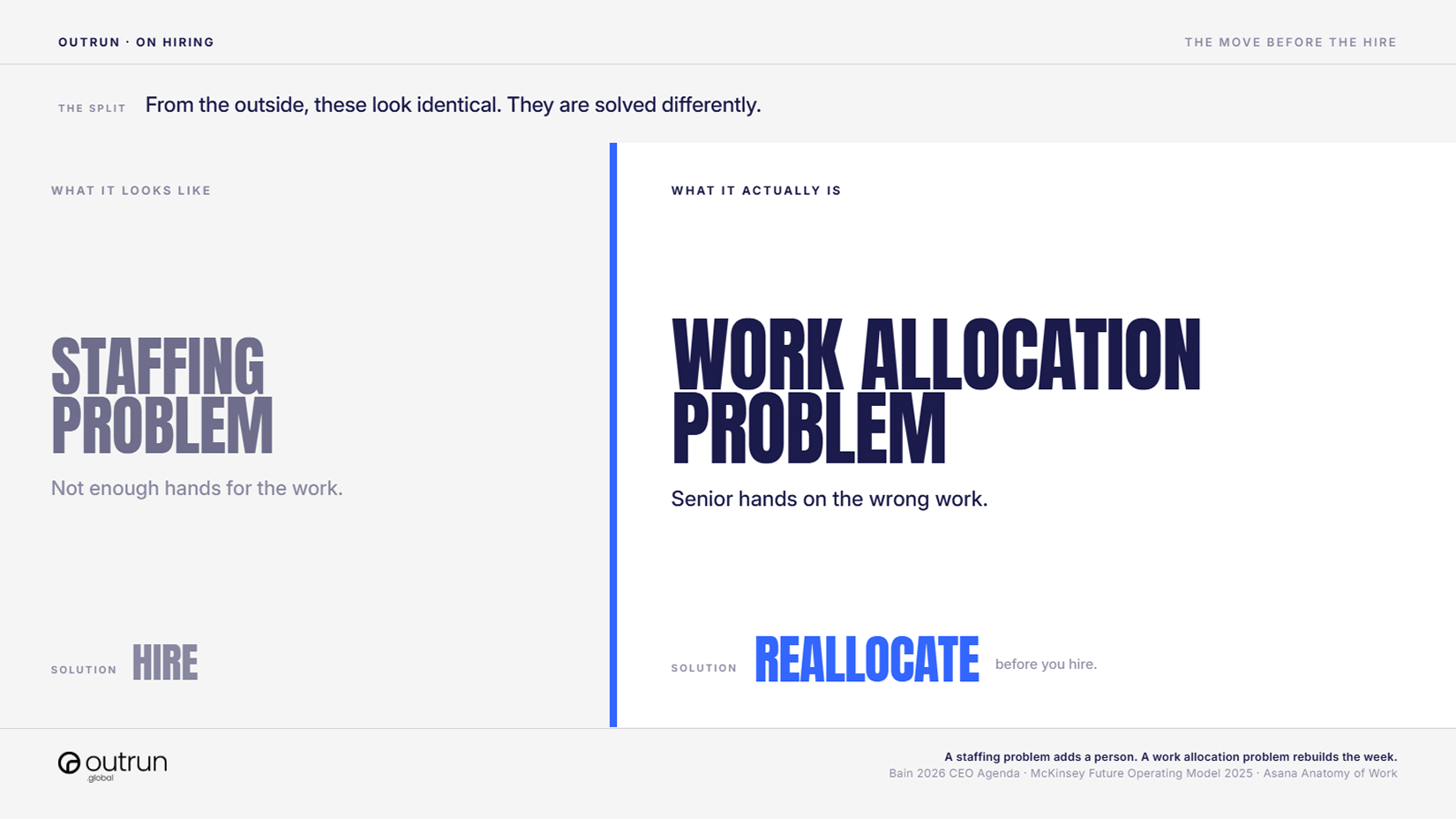
Your Next Hire Might Be a Work Allocation Decision, Not a Headcount One
A work allocation problem is when senior, expensive people are spending most of their week on activities someone else could do, while the work only they can do gets squeezed into the edges of the day. It looks identical to a staffing problem from the outside. It is solved very differently. A staffing problem adds a person. A work allocation problem rebuilds the week.
Five signs you have a work allocation problem, not a staffing problem.
The "we need another person" conversation has come up more than twice this quarter, and the case has changed each time.
Your most senior people regularly say "it's faster if I just do it."
The activities on a senior person's calendar overlap heavily with activities on a junior person's calendar.
Internal status meetings outnumber decisions taken in them.
The new hire you made last year is already being asked to do work the original problem person was doing.
What the research actually says
Two pieces of 2024 to 2026 work make this concrete. Bain's 2026 CEO Agenda concludes that the central problem facing leadership is execution, not strategy: the gap, in their words, is between where strategy is set and how it is delivered. Bain notes that fewer than half of the CEOs they surveyed believe their organisations are agile enough to adapt and execute, and offers three questions every CEO is meant to be able to answer: what work can only you do, and are you actually doing it; what is on your agenda today that should never have reached your desk; where are you being pulled into decisions because the organisation below you lacks confidence or clarity.
McKinsey, writing in June 2025, puts a number on the gap. Their Future Operating Model Survey of 757 organisations finds that even high-performing companies carry roughly a 30 percent gap between their strategy's full potential and the value of what is actually delivered, and they trace it to operating-model shortcomings, not talent.
Neither piece of research is about hiring. Both are about where the work goes. That is the reframe.
The senior-time leak is large, and it is measured
Asana, in successive editions of the Anatomy of Work Global Index, has spent years measuring what knowledge workers spend their day on. The headline finding is that about 58 percent of the working day is "work about work": coordination, status, duplicate effort and chasing, rather than the skilled, strategic jobs people were hired to do. Senior leaders lose around 3.6 hours per week to unnecessary meetings; in the most recent Australia and New Zealand cut, workers estimated they spend 41 percent of the week on low-value repetitive activities, the highest of any country surveyed.
Microsoft, in its 2025 Work Trend Index, found that knowledge workers split their time roughly 57 percent communicating and 43 percent creating. That is the cleanest line in the report, and it makes the same point Asana does in plainer language: the senior, expensive working hour is mostly not the senior, expensive working hour anyone planned.
In Australia, the dollar shape is on record from older Sage research (2017): the average Australian business was spending around 567 hours per year on administrative activity, at a cost of about AUD 79,000 a year. Old, but indicative. New Zealand has thinner data, but MYOB and Forrester found in 2021 that mid-market businesses were losing roughly one and a half days per employee per week to ineffective digital tools and integration, modelled at about NZD 2.2 million per year for a 100-person firm. The IMF and the New Zealand government's own long-term insights work, separately, place New Zealand at about 40 percent below Scandinavian peers on output per hour, and they note that most of New Zealand's growth has come from adding labour rather than lifting output per worker.
The point is not the precision of any one number. It is that across very different sources, the senior week is heavily allocated to activities that nobody would deliberately design into a senior role.
Why the instinct is to hire, and why it usually does not work
Hiring is the move with the cleanest narrative. There is a gap, there is now a person filling it, and the leadership team has done a visible thing. The trouble starts six months in, when the new role gets pulled into the same coordination tax everyone else is paying. The activity is still there, the bottleneck is still there, and now there is another seat to pay for.
PwC's Australian CEO survey makes the loop visible. Around 74 percent of Australian CEOs in the 2025 survey believed their business would still be economically viable in ten years on its current path, against 55 percent globally. PwC labelled this confidence as possibly misplaced. The same survey found 41 percent of Australian CEOs were planning to increase headcount in the next twelve months. Separately, PwC notes that around half of CEOs globally reallocate 10 percent or less of their financial and human resources from one year to the next. So the typical company is confident, hiring, and barely moving the work around. Reallocation is the lever almost nobody is pulling.
Bain's January 2026 reorganisation research adds the punchline. In a survey of nearly a thousand executives and employees who had been through a reorganisation, 88 percent of leaders believed the new structure would deliver on its goals, while only 36 percent of the employees inside that new structure agreed. Restructuring does not fix the work. It moves the boxes.
What reallocation actually frees
McKinsey, in their match-talent-to-value research, gives the textbook description. The exercise starts from the question "what do we need to be able to do to create value", maps where that value is actually created, and then puts the people with the right skills into the most critical roles. In their worked examples, centralising the financial-planning activity alone freed up at least ten full-time equivalents.
In a thirty-person Australian and New Zealand business, that kind of move is rarely a centralisation play. It is more often a tier change: the senior person stops being the chasing-and-coordination layer, and the activity below it gets handed off, formalised or augmented. The Deloitte Pfizer precedent from a decade ago, where scientists had non-core technical and administrative work offloaded so they could spend more time on activities that used their scientific skills, is the same shape.
The piece HBR keeps returning to is that the wins that last are collective. Leaders who chase individual quick wins fall into traps: micromanaging, jumping to conclusions, reacting badly to challenge. Leaders who set up team-enabled wins outperform peers by up to 60 percent over the same window. Reallocation is a system change. The leader is not doing more work. The work is sitting in a different place.
The week you get back
The simplest way to feel the difference is to map one senior person's week, activity by activity, into two columns. Only-they-can-do-this on the left. Someone-else-could on the right. The right column is almost always longer than anyone expects. Then ask the next question: of the right-column activities, which would actually move if the person doing them were good and structured, not heroic? That is the reallocation pile.
You can do this with a whiteboard. You can do it more accurately with an Activity Analysis Session, which is what Outrun runs as the front door to this work. The session maps the week as it actually runs (not as the org chart says it runs), separates the activities that are appropriate to the senior level from the ones that are not, and shows you where the hours are.
Same person. Same salary. A completely different week.
The Australia and New Zealand split
These problems do not look identical across the Tasman.
In Australia, the conversation is solution-aware. Search behaviour, executive conversation and competitor positioning are all dense around hire-versus-outsource, offshore staffing, virtual assistants and on-costs (Super 12 percent from 1 July 2025, Payday Super from 1 July 2026, around 25 to 35 percent employer on-costs depending on the role). The Australian opportunity is to reframe a buyer who already knows they have a capacity problem and is considering the wrong levers.
In New Zealand, the conversation is earlier. The category itself, capacity as the alternative to headcount, has thin search demand. The macro setting (the long-running productivity gap) and the immediate experience (senior people doing low-value work) are both there, but the language for it is not. The New Zealand work is recognition: helping a reader see their own week clearly enough that the reframe lands. That is why the New Zealand intro to this kind of writing rarely starts with cost. It starts with the day.
What this looks like in practice
A scaling Australian or New Zealand business with twenty to a hundred people, growing, with senior staff already too busy, is the standard shape. The conversation usually opens with "we are looking at another hire" and a job spec that is fifty percent administrative activity. The Activity Analysis Session that follows tends to find that more than half the proposed role is reallocatable activity that was already happening, just attached to the wrong person.
The decision that comes out of that session is not always reallocation. Sometimes the answer really is a hire. But the hire is sharper, the spec is tighter, and the rest of the week has been freed before the seat is added. The cost of running the analysis is one week. The cost of hiring into a work allocation problem is at minimum one salary, plus on-costs, plus the same problem in twelve months.
Where cost fits
Cost is a proof point in this conversation, not the headline. Outrun's own activity-based offshore augmentation runs at savings of 60 to 75 percent on remote-capable activities, measured against local hiring costs for the same role; that is not the reason the conversation starts, but it is part of why the maths works when reallocation involves moving an activity off a local senior salary and onto an offshore specialist with the same activity-level training.
Two practical disciplines. First, the savings are activity-level, not blanket. Some activities reallocate cleanly, some do not. Second, the comparison basis matters. Outrun versus a Philippines-direct competitor will not show that range. Outrun versus the local hire that would otherwise have happened will. The Activity Analysis Session is the only honest way to know which kind of activity you are looking at.
What to do this week
Map one senior person's week. Use two columns. Pay attention to the right column. If the right column is heavier than you expected, you have a work allocation problem to look at before you have a staffing decision to make. The Activity Analysis Session is the version of that exercise that produces something a leadership team can act on (it runs from $9,500 NZD, takes about a week, and produces a reallocation map with named activities and an estimated week-you-get-back).
That is the move before the hire.
FAQ block (for snippet capture and AI-engine extractability)
Should I hire or outsource? Map the activity first. If the activity sits beneath the seniority of the person currently doing it, reallocation, whether through internal redistribution or offshore augmentation, is usually cheaper and faster than hiring. If the activity genuinely needs new skills you do not have, hiring is the right answer; the work above clarifies which one it is.
When is it time to hire vs outsource? Hire when the activity needs to sit physically and culturally in the room, requires deep institutional knowledge that has to be built in-house, or carries directional decision-making. Outsource or augment when the activity is repeatable, definable and bounded; for these activities the constraint is usually allocation, not headcount.
How do I scale my business without hiring more staff? Two moves. Map the week of every senior person and find the activities they should not be doing. Reallocate those activities, internally or to offshore specialists, before you add seats. Most businesses with 20 to 100 people find a quarter to a third of senior time available for reallocation.
What are the signs it is time to hire? When the activity needs new judgement, when reallocation has already happened and the constraint is still there, when growth is locked behind a capability you do not have. If the answer to "what would this role do" is mostly activities someone already does, the answer is allocation, not hiring.
How do I free up senior staff time? Activity-level mapping, then reallocation. Identify the activities only the senior person can do, and the ones someone else could do. Move the second list. The Activity Analysis Session is the structured version of this.
Do I have a staffing problem or a capacity problem? Capacity is usually misallocated, not missing. If your senior people are overwhelmed but the lower-tier activity in their calendar is heavy, you have a work allocation problem. If your senior people are doing only senior work and the team is still missing deadlines, you have a staffing problem.