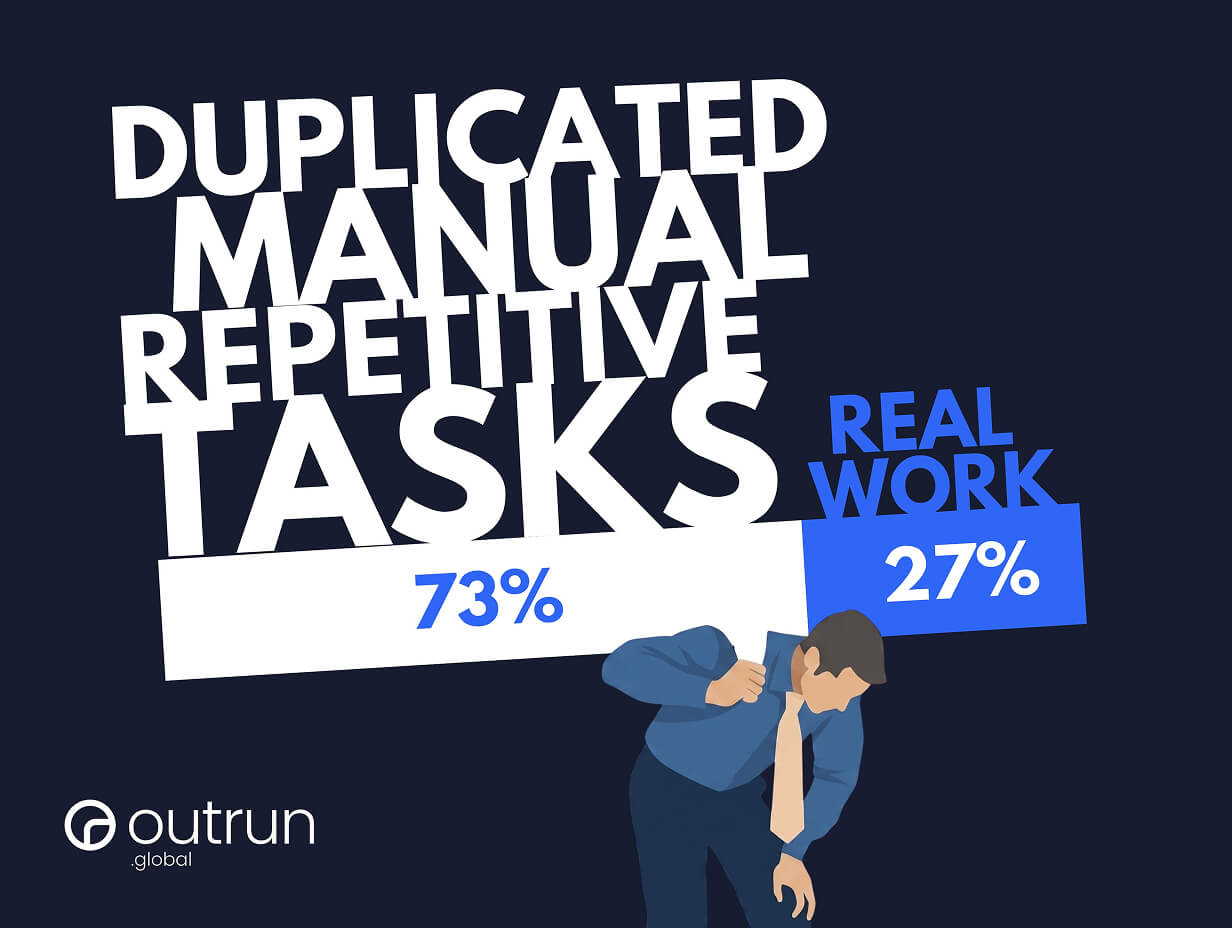
Are your employees stuck in the 27% problem?
In the latest episode of the Fear + Greed Q&A podcast, host Sean Aylmer speaks with Jarra Borman, Director of Strategy at Outrun Global, about:
why employees spend only 27% of their time on skilled work
how role creep reduces organisational capacity
why most AI implementations struggle
and how businesses can identify remote-capable tasks within their teams
Listen to the full episode here.
Overview
Australian businesses are under pressure - rising costs, tighter margins, growing competition, and increased pressure to adopt AI and new technology.
But many companies may be trying to solve the wrong problem.
Instead of focusing on roles, leading businesses are starting to focus on tasks - because much of the work being done today is repetitive, manual, duplicated, or simply too expensive for the level of skill required.
The issue is often not capability. It is visibility.
If your team feels constantly overwhelmed but your actual business output is stalling, you are likely caught in the 27% problem.
According to a global study by Asana, employees only spend about 27% of their time on the actual skilled work they were hired to do. The remaining 73% of their day is swallowed up by what experts call the "work about work" such as administrative quicksand, manual coordination, and repetitive tasks.
The Problem: Businesses Focus on Roles, Not Tasks
When a business feels the pinch of rising overheads and shrinking margins, leaders usually look at their org chart. They evaluate cost centers and job descriptions. But looking at things through a traditional, role-based lens is actually what tanks your capacity.
Roles are broad. Over years of organizational drift, they morph into a chaotic collection of legacy tasks and accidental responsibilities until they don't even represent the core focus anymore. Eventually, the role no longer reflects the high-value work the person was originally hired to perform.
As discussed on the Fear + Greed Q&A podcast, roles are often made up of dozens - sometimes hundreds - of individual activities and tasks, all with different cost profiles and opportunities for improvement.
Example:
Imagine hiring a highly-experienced $150,000-a-year specialist. If they spend five hours every week manually pulling data and building basic reports, the business is effectively paying premium rates for low-value operational work.
The issue is not that the employee lacks capability. The issue is that the wrong work is sitting with the wrong person. That hidden mismatch exists inside many organisations.
We discovered at least 10 common activities in most businesses that consume valuable time across operations, marketing, support and management teams. Check it here: The Top 10 Activities Most Employees Are Trapped In
The question businesses should be asking is not "What does my team need to be doing?" but rather, "What shouldn't they be doing?"
Solution: Getting Deeper into Actual “Work Hierarchy”
To fix this, you have to look past the "job description" and break the work down into its most granular components. In process management, there is a strict hierarchy between a Task, an Activity, and a Process. Understanding the difference is the secret to identifying exactly where you are overpaying for basic delivery.
Once you isolate these granular pieces of work, you can begin unlocking massive cost savings and potentially double your team's day-to-day productivity.
But how exactly do you execute this analysis without disrupting your daily operations?
At Outrun, we help businesses identify the repeatable, process-driven work that is consuming valuable time inside their teams. Through our Hidden Capacity Calculator and Activity Analysis Sessions, businesses can uncover where operational drag exists, identify remote-capable tasks, and explore practical ways to free up their teams for higher-value work.
You can start here:
Hidden Capacity Calculator – uncover where time and productivity are being lost across your team
Activity Analysis Session – a structured review of the tasks, activities, and workflows creating operational bottlenecks
Or listen to the full Fear + Greed Q&A episode with Jarra Borman and Sean Aylmer here.